Reading with Claude
Why I'm using AI to read, not to write

Short updates:
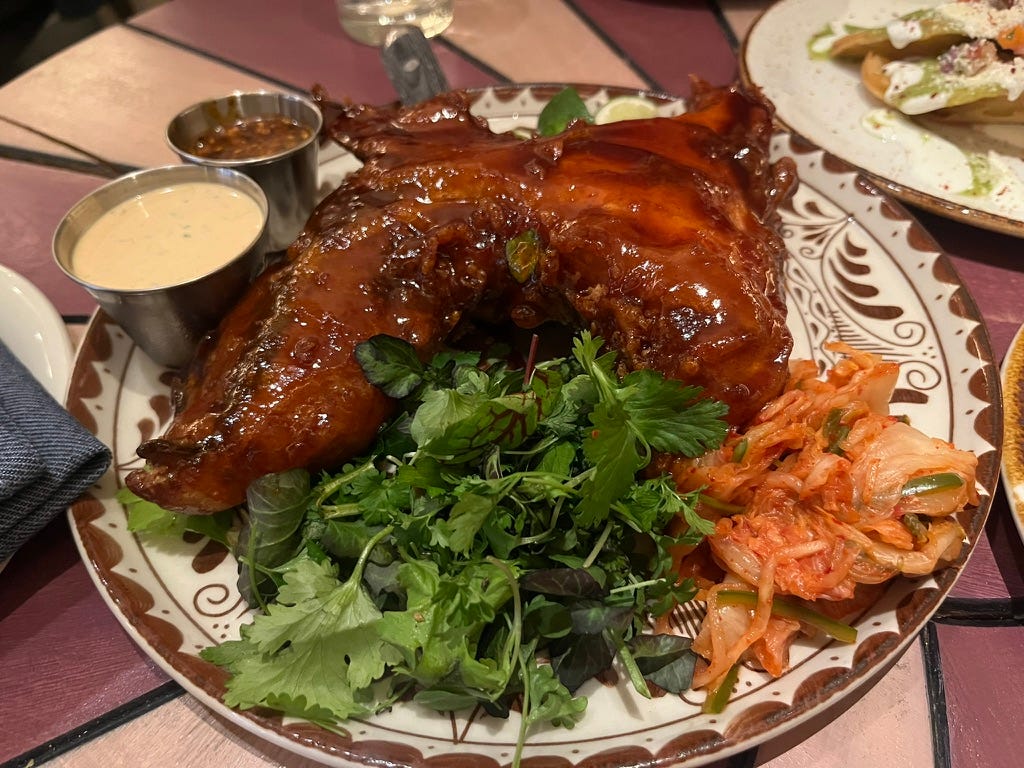
We went to another Thalia Hall show, this time for Kishi Bashi. We went back to Mariscos San Pedro before the show (last time). I got a tip from Amy Cavanaugh at American Weekender1 about a fish collar dish, so we ordered it.
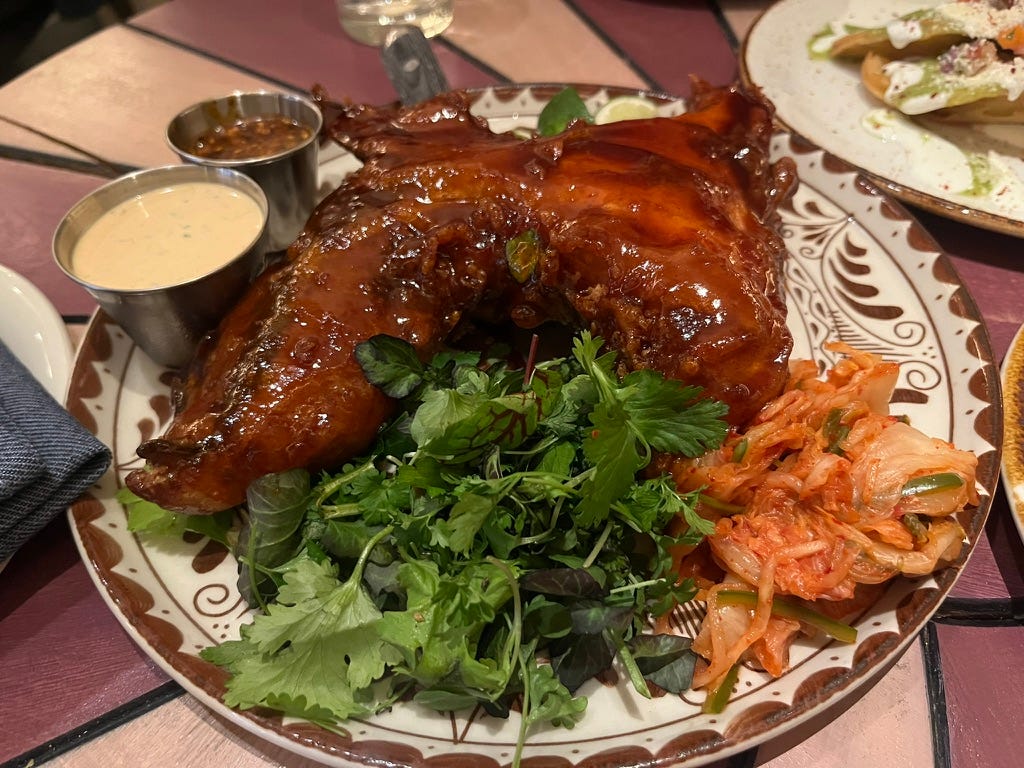
It’s Korean-style fried cobia collar, so we’re talking about Korean fish tacos with some of the richest, fattiest fish parts around. Fantastic.
I have 2 trips coming up: Charleston for work, and Copenhagen/Malmö for fun—more on the latter below. So I promise I’ll shut up about AI after this post for a while.
Here’s a podcast episode/transcript that’s relevant to my post. Philosopher C. Thi Nguyen talks to Derek Thompson about value capture, the idea that once you start optimizing for some metrics that are aligned with your goals, you may end up chasing the metrics even if it goes against your original intent. They also talk about his earlier work on philosophy of games, which is relevant to my last post.
The last section where they try to sum up the conversation is so, so, good.
We have a problem of too much supply of artistic work, not too little. Ted Gioia made this argument back in 2023, before we really started seeing a lot of AI-generated images and text.2 Some numbers he cited, many of which I’m sure are bigger now:
A hundred thousand songs are uploaded daily to streaming platforms.
In the last year 1.7 million books were self-published.
2,500 videos are uploaded to YouTube each minute.
There are now 3 million podcasts—and 30 million podcast episodes were released last year.
86% of youngsters want to grow up to become influencers, and contribute to these impressive numbers
Even if 99.9% of these songs, books, etc. are crap—and I don’t think they are—that’s still a lot more good, interesting work than a person can take in.
So a tool that helps people create more art isn’t solving a real problem. But a tool that helps people make sense of this deluge, that helps people encounter and appreciate more of it, that’s doing something. And that’s how we should be using AI chatbots.
What am I going for?
I’ll focus on reading in this post, because that’s where I had the biggest gap between what I wanted vs reality.
I wanted to spend more time reading longer works that engaged all of my attention—this includes books, but also something like Anton Howes’s work on the history of salt—and less time reading short, surface-level pieces and social media posts.3
A big problem was the general lack of time—a full-time job and 2 young kids take a lot of time, and I can’t “solve” this problem unless we make drastic lifestyle changes. But I did find that, as the older kid (now 4) becomes more independent, I can spend time in the same space as him, just doing my reading.4 He can figure out how he wants to spend his time, which is sometimes picking out a book for himself, and really, whatever he finds interesting at the time is worthwhile.
This generated hours of reading time, especially on weekends. But there were 2 more separate issues, which I’ll talk about in more detail:
Decision paralysis in terms of what to read—there were too many choices, and I had trouble committing.
I needed to cut down on lighter articles that I was reading.
I’ll talk about how Claude addressed both of these. Read the footnote for more technical details5.
Book recommendations
I’ve already given an example of how good recommendations can get me going on a book, when I talked about how Claude helped me learn Mexican cooking6, but I have some new developments to talk about.
This summer, we’re going to friends’ anniversary party in Malmö, Sweden, and we’ll also spend a bit of time in Copenhagen, where we would fly into, and take a train on a long bridge to get to Malmö. I’ve been to Europe, but both Sweden and Denmark are new to me. This made me wonder what books might be interesting to check out before we head out.
I quickly figured out that, if I want a nonfiction book with an urbanism focus, I’d have to read something by Jan Gehl, an architect from Copenhagen who’s written extensively about designing cities for pedestrians and cyclists. You don’t need AI to get to this point.
But I also wanted to read some fiction. And having not read much from Sweden or Denmark7, I would’ve had a hard time coming up with a short list of compelling books. I got about 10 recommendations from Claude, which has some really important context—what books I’ve read and what I think of them—and I narrowed them down to these 4 books I could get from the library.
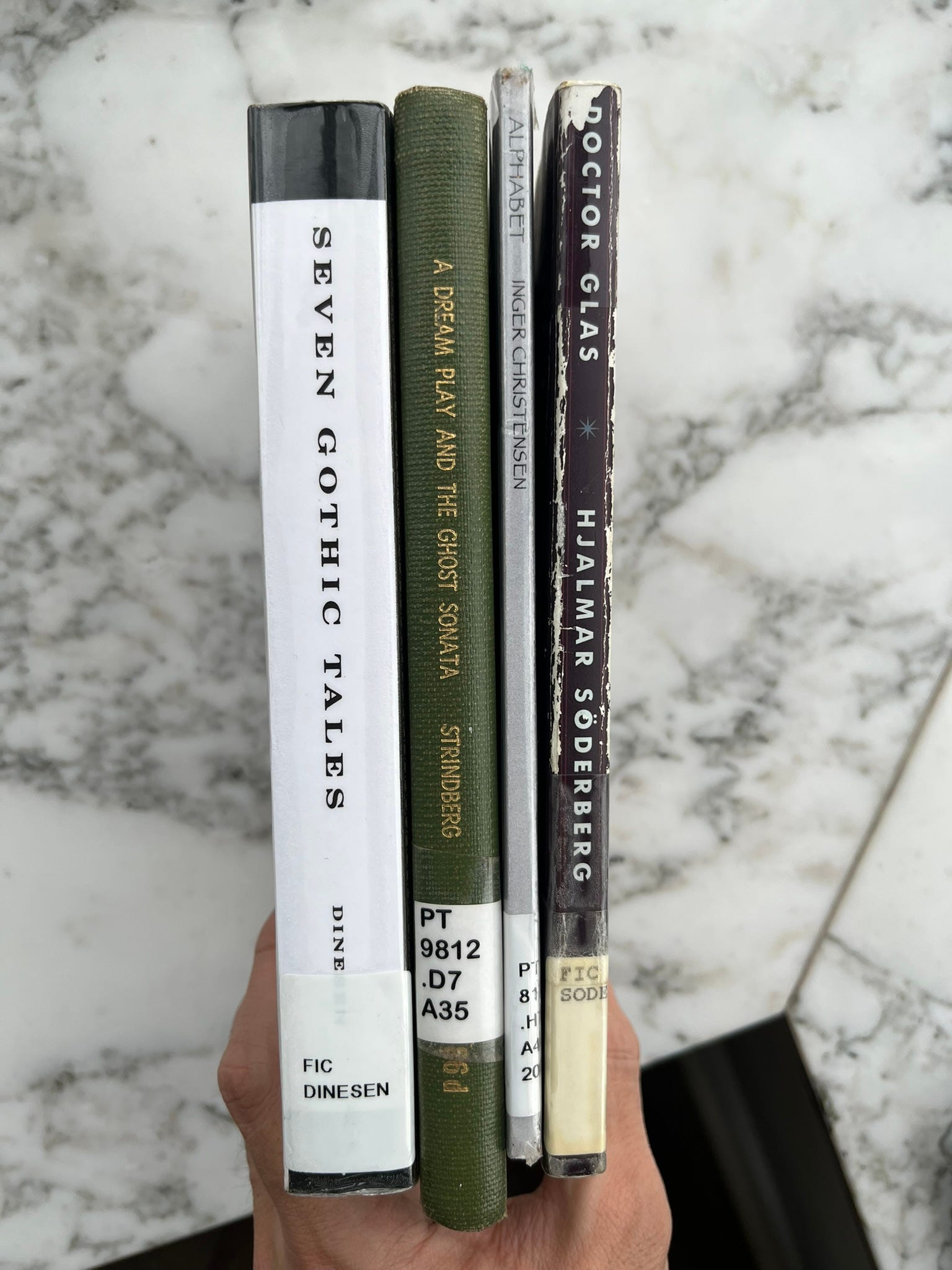
(PSA: I don’t think I can plug the library enough. It’s great for lowering the barrier to entry. Just check out some books, and if I don’t get to it, that’s fine. I didn’t pay money for it.)
Note that the Dinesen, Strindberg, Söderberg books are true classics in Scandinavian literature, and would rank high if I searched for Danish and Swedish classics. But I would have had a hard time ever getting to alphabet, a book of poetry where the number of lines in each section follows the Fibonacci sequence.
Claude’s highest recommendation was actually Strange Stories by Villy Sørensen. The Chicago Public Library doesn’t have this, so I’ll make it a project to find it at Politikens Boghal in Copenhagen. At some point, I also want to check out Aniara by Harry Martinson, an epic sci-fi poem about space colonization gone awry—so totally irrelevant to the trip in terms of content.
When you ask AI for recommendations, it’s wise to stress-test them, to make sure it’s not just reinforcing its own biases. When I asked Claude to play devil’s advocate against its own recommendations, it recognized that most of the books were in the “cerebral European modernist” mold8, and came up with less highbrow stuff, including Hans Christian Andersen and The Wonderful Adventures of Nils, two children’s book staples from these countries.
Now, I haven’t gone deep into any of these books yet, and I might not like them all, but I’m pretty happy that these are the ones I’m going to try.
Article triage
I’m guessing some of you also have this problem, of subscribing to too many things. It’s so easy to find someone writing something interesting, and click subscribe. And it’s hard to unsubscribe even if you don’t read most of what you get in the mail, because you occasionally do read something good from them.
So I’m getting too many posts from too many newsletters, not to mention articles from social media and friends. I often start reading before I realize it’s not something I want to keep reading, or, I finish reading and realize that it wasn’t really worth my time. So I need a way to triage the flow of articles.
Let me step back, though, and talk about why you might want to read some piece of text on the internet. I think there are 4 overlapping reasons.
You want to connect with someone. If your friend wrote something, you want to read it so you know what they’re doing and what they’re thinking. If your friend recommended something, you want to read it and respond. Even if someone isn’t quite a friend, you might care about them enough that you want to do these things for them.
You want to understand something. Everyone’s different on this, but for me, one top priority for understanding is anything involving public transportation in Chicago.
You want to be entertained. This could be a fun travelogue from a place you’re unlikely to go to.
You want to be aware of something. Maybe you saw something in the news, and you just want to know the basic outlines of what happened.
For 1 and 2, you really should read it. You can’t outsource your human connections and your understanding to AI9. If it’s 3, again, you can’t outsource enjoyment to AI, but maybe you want to read it when you have time. If it’s 4, you can just read a summary10.
What’s tricky sometimes is that an article can be about something you really want to understand, but you don’t know if it goes deep enough to give you new insights. This is why, in addition to an overall summary of a piece, you want a quick rundown of the themes that are inside.
One recent example for me was Paul Krugman writing about technological change and the economy (paywalled). Claude’s summary initially made this look like something I can ignore—if all it says is “AI is unlikely to lead to massive unemployment, but that doesn’t mean workers could lose out“, then I already knew that. But I also had Claude give me bullet points of what the article spends time talking about, and I decided it was worth reading. And it really did give me a framework to think about how something like AI could affect the economy11.
Through recommendations and triage, Claude is helping me read more good things—things I’m interested in, things I can learn from.
What I’m listening to now
This is Taracá by Jorge Drexler, an Uruguayan singer based in Madrid. This is the second time I’m highlighting him in this space. In a funny coincidence, the only repeat artists I’ve had are also the first 2 artists I talked about12.
A quick search revealed that “Taracá” is onomatopoeia for the sound of drums in the Afro-Uruguayan style of drumming called candombe. But apparently there’s also a pun here. In the Uruguayan dialect of Spanish, estar (to be) can be shortened to tar, so “taracá” could mean “tar acá” (to be here). This pun is spelled out in “El tambor chico”, where both “taracá” and “estar acá y estar ahora” (to be here and to be now) appear in the lyrics.
The first track also has wordplay with drumming. The literal meaning of “Toco madera” is “I touch wood”, where the phrase has the same superstitious meaning as “knock on wood” in English. He also sings it to mean “I play the wooden drums”. These are fun tracks even if you don’t know these things—I didn’t know until I started writing this segment.
My favorite song here, though, is “¿Qué será que es?”, a contemplation on the meaning of life. This is a Spanish cover of “O Que É, O Que É?“, an 80s samba song by the Brazilian singer Gonzaguinha. The original is perfect in its own way, and Drexler adds little twists to make it work.13
Great source for tips on where to eat and drink at travel destinations in the US.
Yes, I’m using the work of someone who is extremely anti-AI, to argue for good uses of AI. Such is life.
Ted Gioia’s advice on reading books (paywalled) is also quite relevant here.
This works a lot better when my reading is done with physical books and magazines rather than on a screen.
I have been using the “projects” feature of Claude, where you can add context relevant to a topic. I have a project for my reading, where I put in what I think of books I’ve read.
In addition, Claude (and I believe both ChatGPT and Gemini) has a feature called skills, where you can specify how you want Claude to perform certain repetitive tasks. The easiest way to create a skill is to ask Claude to create a skill for something you want it to do—Claude has a built-in skill to create skills.
Here are the skills I used to get the results I talk about in this post:
book-recommender: This skill makes sure that each book that Claude recommends comes with specific reasons why I might want to read it.
recommendation-table: This creates a table summarizing a bunch of recommendations, rating each along multiple criteria, like “how much Claude thinks I would enjoy reading this” or “how relevant this is to visiting Copenhagen”.
devils-advocate: This challenges ideas and tries to create good arguments against them.
article-triage: This summarizes an article, with key takeaways and reasons why I might want to read or skim it.
I still stand by the 3 principles of AI use in that post.
Here’s a rundown of Swedish and Danish stories that I’m familiar with.
Some children’s stories from Hans Christian Andersen
Anime version of The Wonderful Adventures of Nils
The mystery film The Girl with the Dragon Tattoo, which I only saw because I bumped into friends who were going to see it
The indie film Border, which played at the Chicago International Film Festival—very weird and very good
The horror film Midsommar—set in Sweden but written by an American
This sounds really insufferable.
This is where the value capture concept in the Nguyen–Thompson conversation is relevant. In search of “efficiency”, you might end up reading summaries of everything, losing human connection, understanding, and joy in the process.
This desire to be on top of things is pernicious, and a big reason why so many of us feel like we don’t have enough time.
One theme is “Hicksian bias”, which is the bias that a certain technology has for favoring capital or labor—AI seems to be capital-biased, at least on current evidence. The other theme is network effects and monopolies that they create. We really don’t know if AI will make the problem of monopolies better or worse.
I talked about Natalia Lafourcade for my first post and again last year. I talked about Drexler’s 2017 album Salvavidas de hielo in my second post.
I did highlight the Japanese band Yura Yura Teikoku and its singer Shintaro Sakamoto on separate occasions.
This reminds me of how I liked his song “Quimera”, a bossa nova song in Spanish.
I’m so glad you enjoyed the fish collar! I am a fan of Swedish crime fiction and enjoy the Kurt Wallander books by Henning Mankell - I also liked the show Young Wallander that ran a few years back.