When the game is your life
Artificial intelligence always changes how we think about human intelligence
Short updates:
A couple of Saturdays ago, our 4-year-old lost his backpack on a bus. The next day, he and I went to pick it up from the lost & found at CTA’s North Park Garage.

Now, this isn’t what I would’ve planned for my Sunday, but it was great for him to see a bus garage, with lots of bus drivers hanging around in the building—it’s always good to see more of how things work. And this was a nice echo of a picture book we’ve read for a long time.
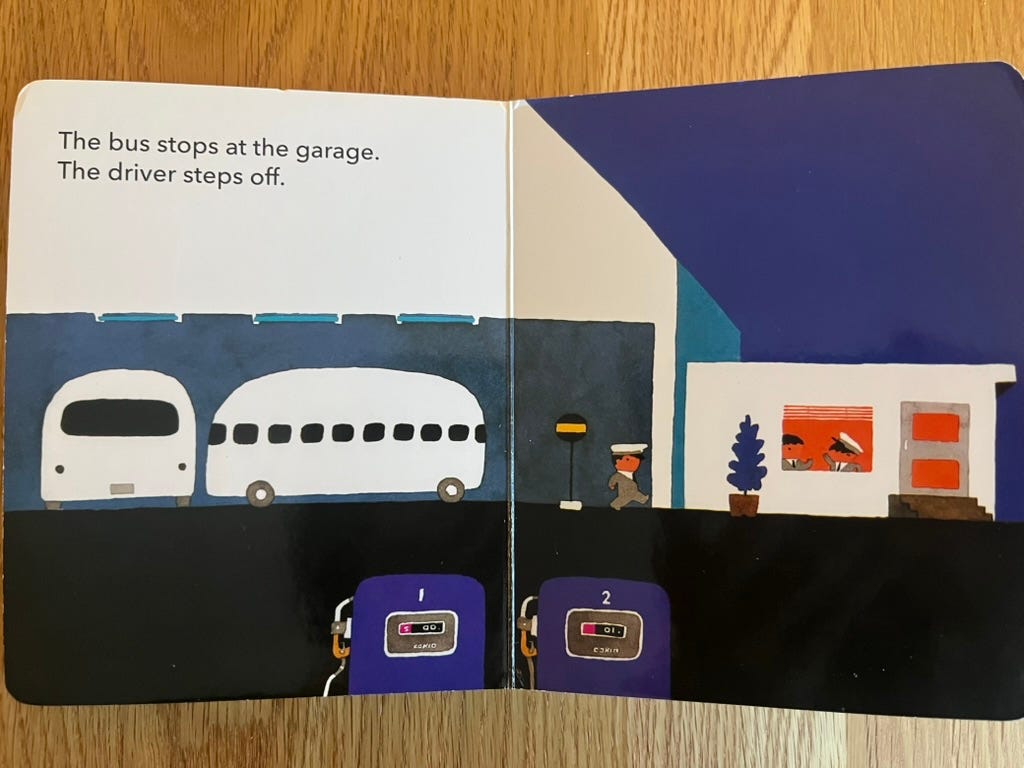
Bus Stops by Taro Gomi (1985) The bus garage was half a mile away from Kabobi, our favorite Persian restaurant in Chicago (or anywhere). We ordered takeout, and that was everyone’s dinner. We’ve had trouble trying new things at Kabobi because we simply have to get the lamb koubideh (ground lamb kabob) every time, and the portions are so generous. This time, we were able to get kashkeh bodemjan (eggplant dip with fermented whey) which was great.
Persian restaurants like Kabobi and Noon-O-Kabob have long been hubs of the Iranian community. We are weeks into a war with Iran that we did not ask for and do not approve of. If you’ve never had Persian1 food, I highly recommend trying it as a way to experience one wonderful aspect of Iranian culture.Here’s a provocative essay by the Berkeley philosopher Alva Noë, with the subtitle “For all the promise and dangers of AI, computers plainly can’t think. To think is to resist – something no machine does”. I agree more than you might think.

The extent to which we regard something as behaving in an intelligent manner is determined as much by our own state of mind and training as by the properties of the object under consideration.
—Alan Turing, “Intelligent Machinery” (1948)
It’s been 10 years since AlphaGo defeated Lee Sedol, one of the strongest (human) go players of all time. That was one of the first big public demonstrations of the power of deep learning—an early phase in the ongoing AI boom2. It may also end up being the last dramatic moment in the long history of people trying to get computers to play games3.
Alan Turing, the pioneer of computer science and artificial intelligence, thought games were a good place to demonstrate a computer’s intelligence4. He even developed what may be the first computer chess program. This is the thread that leads directly to Deep Blue beating Garry Kasparov in 1997, the other famous human-computer contest5.
Here’s what I’ll tell you about instead: in the early 2010s, just before AlphaGo, computer shogi programs started defeating top-level human players. This is barely known outside of Japan, but it was a big deal there. I watched some of the game videos in real time, and closely followed the Twitter discussions on what it all meant6.
I find that this episode informs my view of what happens when computers surpass humans at something we thought was uniquely human.
What is shogi?
Shogi is Japanese chess, and I mean that pretty literally. You may know that chess is a game that developed from an ancient Indian game called chaturanga. Shogi is another descendant of chaturanga.
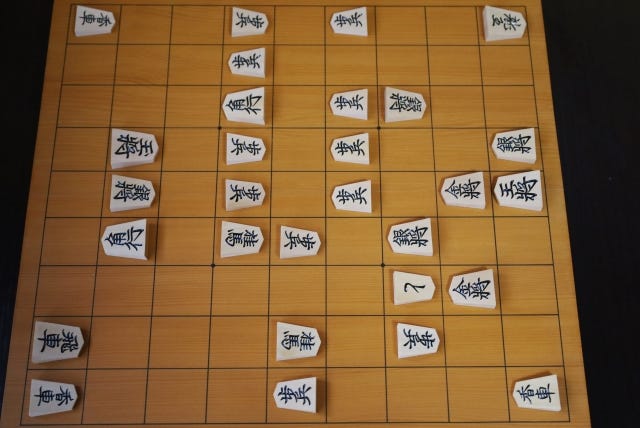
There are many commonalities. It’s a 2-player game on a square board, with the objective of capturing the opposing king. Each side has a row of pawns, there are bishops and rooks, and so on.
There are also many small differences, like the board being 9-by-9 instead of 8-by-8, and how every piece in shogi (except the king) can get promoted to a stronger piece.
But most importantly, when you capture a piece in shogi, you hold on to it, and later in the game, you can spend a move to place it back on the board anywhere as your own piece—chess players might recognize this rule as being similar to a chess variant called crazyhouse.
This last rule often allows for a long sequence of checks7 that leads to a checkmate, and shogi puzzles usually require the attacker to find such a sequence, where every move directly threatens the king. Strong shogi players are capable of finding these sequences very quickly8.
It pains me to say this as someone who prefers the game of go, but shogi is by far the most popular traditional board game in Japan. If you talk to a random person in Japan, they’re much more likely to know the rules of shogi than the rules of go.
How do you become a shogi professional?
Before going into how computers beat human shogi professionals, it’s important to talk about how professional shogi players are not normal people9.
In order to become a professional shogi player, you first need to enter Shōreikai (奨励会10), which is the apprentice school with the Japanese Shogi Association, before you turn 19.
But wait, before you can apply for Shōreikai, you need a recommendation from a professional, who is agreeing to take you under their wing as a disciple. So what you really need to have done is to play at local clubs and do well in tournaments when you’re in grade school. And if you’re serious about shogi, you can get connected to a pro who can help you through this process.
Entering Shōreikai involves a test, where you play fellow applicants as well as people who are already in Shōreikai. Because they are so selective, even the weakest Shōreikai players are already very strong amateurs11. Oh, and there’s only two locations for Shōreikai—Tokyo and Osaka—so you may have to move.
Once you enter Shōreikai, you play in league games against fellow Shōreikai members. If you do well in the league games, you rank up. Depending on how strong you are when you enter Shōreikai, you may need to rank up 9 times, before you can finally become a professional shogi player. Only 10-20% of people who enter Shōreikai become pros in the end.
If you are exceptionally strong, you can get through all this as a teenager. However, many players go well into their 20s, trying to become pros. Since there are age limits—you need to reach 1-dan by age 21, and become pro by age 26—most players consider Shōreikai to be a full-time endeavor, and they rarely go to college.
Imagine the pain of missing becoming pro at age 25, having put your life into this game.
Imagine the feeling of overcoming these odds to become a professional, a select group of 300-odd people in the 100-odd-year history of the Shogi Association.
What happened at Denō-sen
Around 2010, computer shogi programs got good enough that the pros started taking seriously the possibility that computers would surpass them in the near future. This led to a series of human-computer matches that ran from 2011 to 2017, called Denō-sen (電王戦), which means something like “Electronic King Match”12.
One aspect that made Denō-sen different from Deep Blue and AlphaGo matches was that from 2013 to 2015, Denō-sen was a 5-game series between 5 different professionals and 5 different shogi programs. If you include the developers—and you should—that’s at least 10 different personalities involved every year13.
In 2013 and 2014, computers won the 5-game series against teams of pros who were mostly not near the top level. 2015 was when the pros got serious, with a lineup of strong young players who were familiar with computer shogi, and who were expected to win some top-level tournaments in the future14. This series was also the most dramatic.
Game 1 between Shintarō Saitō and Apery was a fascinating study in game etiquette.
In a game like shogi, the rules are easy to write down, but in human play, there are certain conventions. Playing on when it’s obvious that you have no chance of coming back is often considered bad form—you’re wasting everyone’s time, and might even be insulting your opponent’s abilities.
But how do you program that into a computer? In games between two computer shogi programs, it was often seen as desirable, even beautiful, that each program would simply play the move that it considers best, and let the chips fall where they may.
At Denō-sen, developers were given the ability to resign on behalf of their programs. In this particular game, Apery’s developer talked to Saitō beforehand, to let him know that he would not be resigning and his program would continue playing until the end—he thought that was the most computer-like way for the game to go. And this became reality, as Apery played a sequence of desperate checks before Saitō finished off the game with a checkmate.
Even though Saitō himself was fine with the situation, many shogi fans saw the program’s play as disrespectful.
In game 2, the professional, Takuya Nagase, was ahead in his game against Selene, when he intentionally played a move that did not promote his bishop when he could have. Computer shogi programs have a feature that allows them to think about possible next moves when the opponent is thinking—much like a human player would. Nagase knew that Selene would have expected him to promote the bishop, and would have been thinking about the followups. By not promoting the bishop, he was making Selene’s (inflexible) analysis obsolete.
He was hoping for Selene to spend more time thinking. What actually happened was that this revealed a bug in Selene, which played an illegal move and lost.
So the pros were up 2-0. But in games 3 and 4, the computers won convincingly, and it was down to Chikara Akutsu and AWAKE in game 5 to decide the winner of the series.
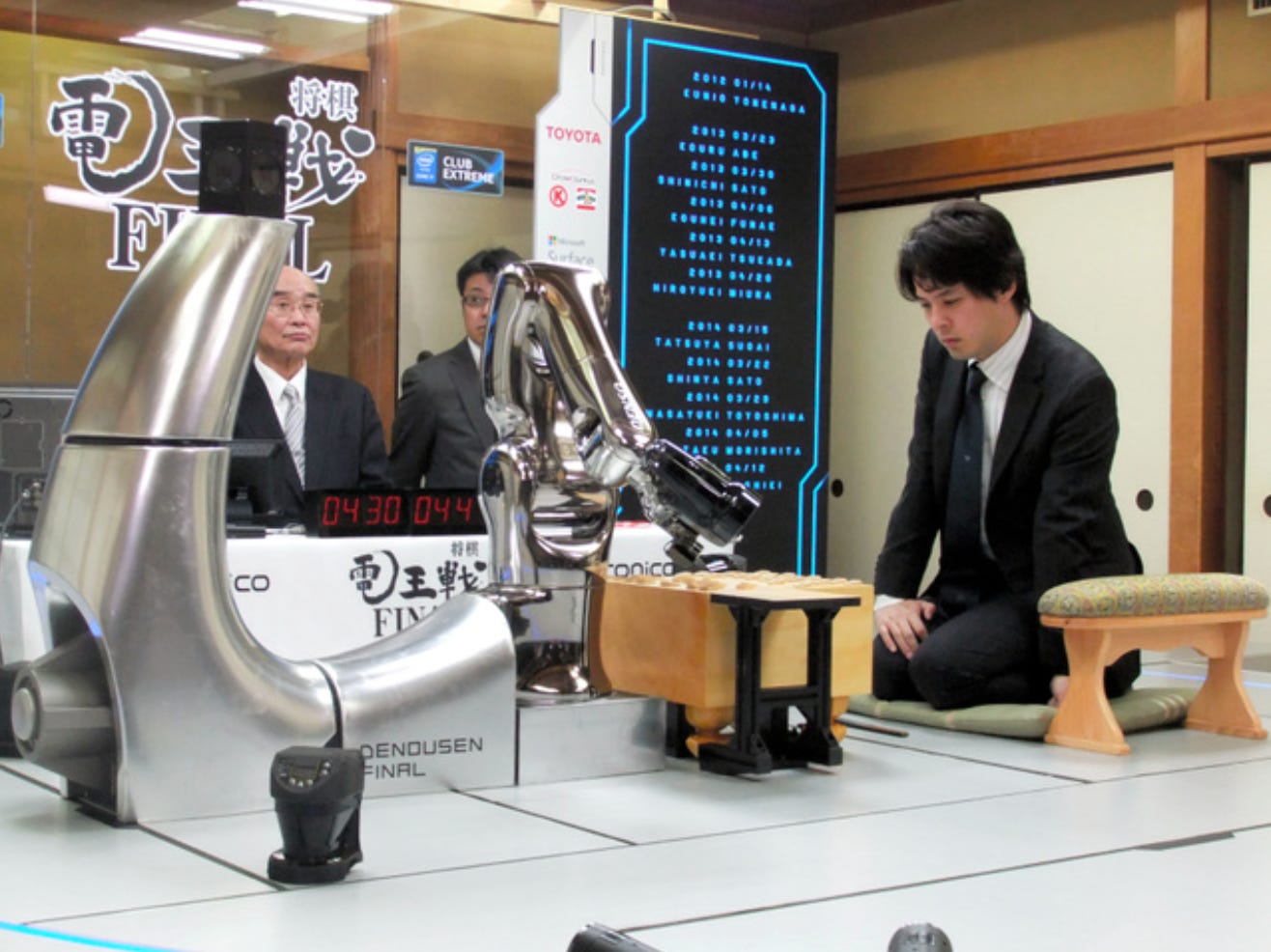
Akutsu was under immense pressure to win the series at all costs. What he did was to direct the game into a known trick play, where a computer loses its bishop, but only after a long sequence of moves—which makes it harder to detect for the computer.
After only 21 moves, once the trick was in place, AWAKE’s developer resigned the game. He was a former Shōreikai member who could not become a professional, and his main interest in building AWAKE was to help professionals get stronger. For him, the trick play made this game pointless.
In the end, the pros won the 2015 series 3-2, but 2 of the wins involved specific anti-computer tactics. To an objective observer, the eventual outcome here was obvious. Denō-sen continued in 2016 and 2017 in a new format, but the humans could not win another game, and the series was discontinued.
What’s the point of playing now?
As in chess before and go later, people worried that the computer becoming stronger than the top humans would make people lose interest in shogi. This has not been the case for any of these games.
People still enjoy playing, and they enjoy watching the best humans play against each other. Yes, human professionals’ egos may have been badly bruised, but they are still highly respected for being the best humans at what they do.
One thing we discovered about these games is that computer programs may be able to figure out “the best possible move” in a given position, but it’s your best move only if you can figure out the correct followup to every response—something not even the best human players can always do. On the flip side, some moves are suboptimal according to the computer but still very difficult to answer for a human opponent.
In short, there will always be drama in a game between two humans.
The strongest shogi player right now is Sōta Fujii, who turned pro in 2016 at the age of 14, exactly when Denō-sen was happening, and he has made no secret of studying with the help of computer programs. In 2023, he held all 8 of the major professional titles, leading to a surge in interest for shogi. He is undoubtedly stronger because of computers, which everyone knows are stronger than him, but this does not seem to have dimmed his popularity.
What about the idea that games were a good demonstration of a computer’s intelligence?
We now know that these games are some of the easiest things for computers to learn. Rules are fixed, and results are well-defined. Much of life, where people don’t even think to mention “intelligence”, does not work like that15.
People no longer talk about these games as pinnacles of human intelligence, and they’ve almost forgotten that that’s how people used to talk. Partly, that’s self-preservation. We don’t want to confront that computers are better than humans at something we thought was central to human intelligence. But partly, we also learned the truth, which is that these games were not central to human intelligence.
We will keep moving the goalposts, and sometimes, we will be right to do so.
What I’m listening to now
Fabiano do Nascimento is a prolific Brazilian guitarist, and here’s his album Vila.
Do Nascimento16 comes from the Brazilian classical guitar tradition, but his recordings are very genre-fluid. He usually lives somewhere in between jazz, classical, and ambient music. For this record, he collaborated with Brazilian trombonist Vittor Santos and his orchestra.
The strings are very prominent, but used differently. Songs like “O Tempo (Foi O Meu Mestre)” and “Spring Theme” have a strong bossa nova feel, while “Valsa” is a contemplative “waltz” that honestly doesn’t seem great to dance to.
The trombone in “Tema Em Harmônicos” is wonderful.
This is good focus music, perhaps for playing shogi.
Iranians call their restaurants “Persian”, I think for two good reasons: Their cuisine is a continuation of centuries of cooking in the area, which was called Persia until 1935. And the name “Iran” has a very negative connotation in the US, and businesses wouldn’t call themselves “Iranian” if they want to make money.
Many experts would place the beginning of the deep learning revolution at AlexNet, a computer vision model, in 2012. The key technique there, the convolutional neural network, was also a key feature of AlphaGo.
The Turing test is of course a game.
Deep Blue did not employ any of the machine learning techniques that we now recognize as ways to get computers to learn. It now seems much more of a one-off than AlphaGo, which used techniques like the convolutional neural network and reinforcement learning, which are very much part of the AI boom.
I got to know Issei Yamamoto, one of the developers of Ponanza, a top program at the time. He’s now the founder-CEO of a self-driving EV startup.
For people who aren’t up on chess terminology: checks are moves that threaten to capture the king on the next turn. They require an immediate response, since you lose if you lose your king.
This rule is also one factor that made shogi more difficult than chess for computers. In chess, the game becomes simpler as pieces get captured and leave the board. In shogi, captured pieces never completely leave the game, so the complexity of the position doesn’t decrease as the game goes on.
There’s varying degrees of madness to top-level chess and go as well, but I think shogi takes the cake for the sheer difficulty.
It means something like “Encouragement Club”, which sounds like a euphemism given what I’ll describe.
Shōreikai players are ranked from 6-kyu to 1-kyu, then 1-dan to 3-dan. But 6-kyu in Shōreikai is equivalent to somewhere around 3- to 5-dan in amateur ranks. Go players would recognize how professional ranks are different from amateur ranks.
The Japanese Wikipedia page is a good place to read more about this, with Google Translate.
The name of the tournament is a riff on existing professional tournaments like Kiō-Sen (棋王戦), which means “Shogi King Match”.
This also points to the lack of huge corporate backing for computer shogi programs at the time. IBM developed Deep Blue, and DeepMind—now part of Google—developed AlphaGo. Each of the shogi programs that appeared in Denō-sen was developed by a small team, often consisting of one person.
All of the major titles in shogi have corporate sponsors—often newspapers that get to report on the games exclusively. Before titleholders could play against computers in an official capacity like Denõ-sen, the Shogi Association needed to negotiate with the sponsors, and this prevented truly top professionals from playing against computers until 2016.
To be fair to actual AI researchers, I think most of them were aware that games were convenient places to demonstrate the ability of AI systems.
“do Nascimento” is his last name, and I just wanted to write it in the most confusing way possible.