Short updates:
For Open House Chicago in October1, we explored the western part of the West Loop, where the Metra tracks go over Ashland. We saw Ignite Glass Studios, where we watched artisans make drinking glasses and horses—a huge recommendation generally for anyone with kids is to see places where things get made—District Brew Yards, where we didn’t do the OHC tour but had lunch from Lillie’s Q and drank self-serve beer by the ounce, and The Roof Crop, where we saw the basil being served at Maxwells Trading.
At the Chicago History Museum, there’s now an exhibit about the history of Latinos in Chicago, called “Aquí en Chicago”. Some background on the Tribune—lack of Latino representation at the museum led to a protest, which led to this exhibit.
And this just came in: Time Out named Pilsen Community Books the best bookstore in Chicago. It’s not big, but it really is good.
Everyone’s doing end-of-the-year posts, and this is kind of one.
I talked about Silvana Estrada in the last 2 posts, and I will keep doing it, because her latest album is my favorite from the year.
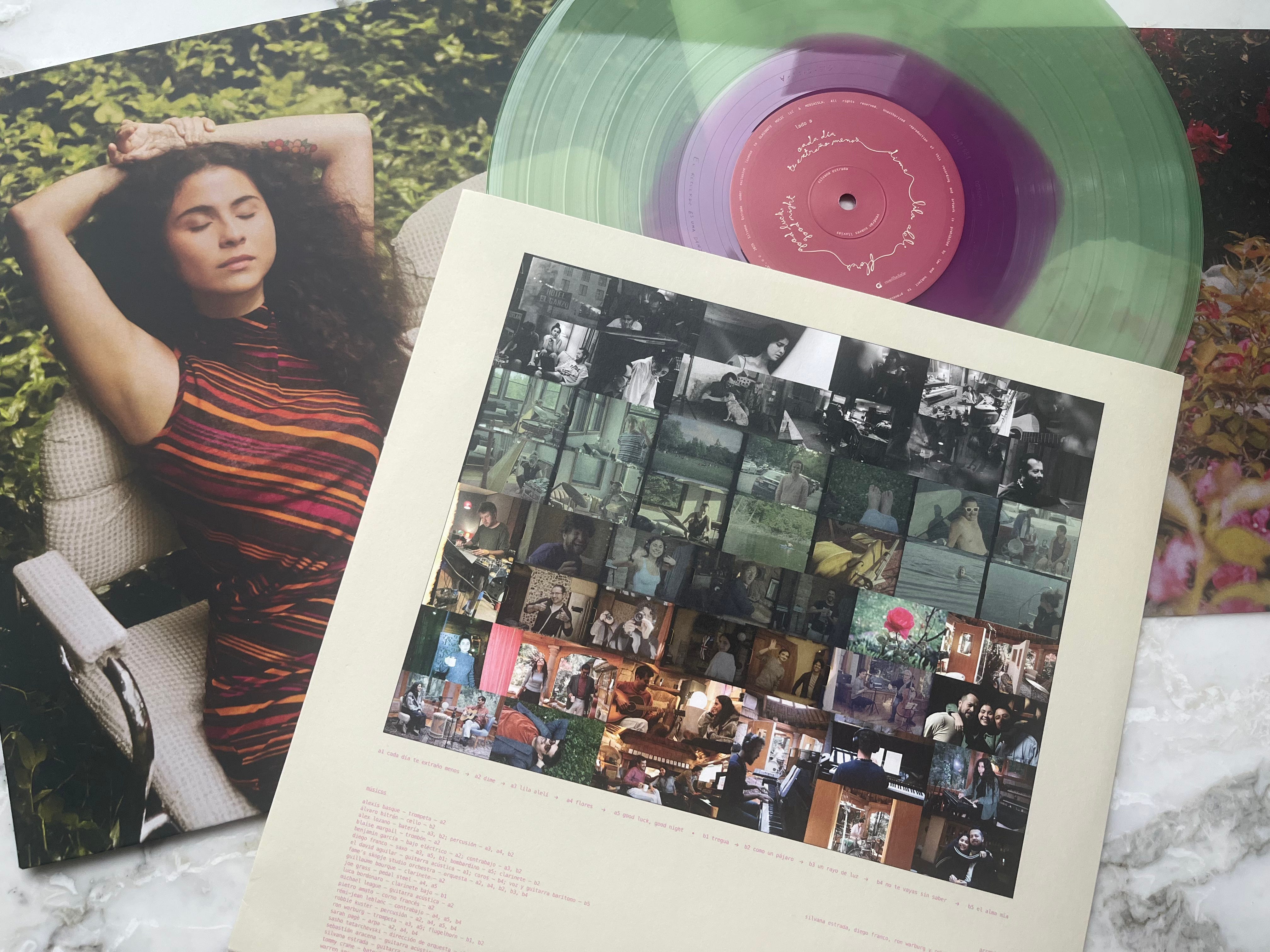
Last month, we spent Thanksgiving with my parents in Memphis and came home on Black Friday, so Julie and I could make it back for her concert at Thalia Hall that night. Despite a bit of a language barrier—we estimated about 80% of the audience was Spanish-speaking, and I understood maybe just over half of her Spanish monologues in between songs—this was one of the best shows I’ve been to in years.
There were two strands of thought that came to me repeatedly during the show. One was the parallel with Weyes Blood, whom we also saw at Thalia Hall in 2019. The other was the depth and breadth of the Spanish-speaking musical culture that I’ve only dipped my toes in.
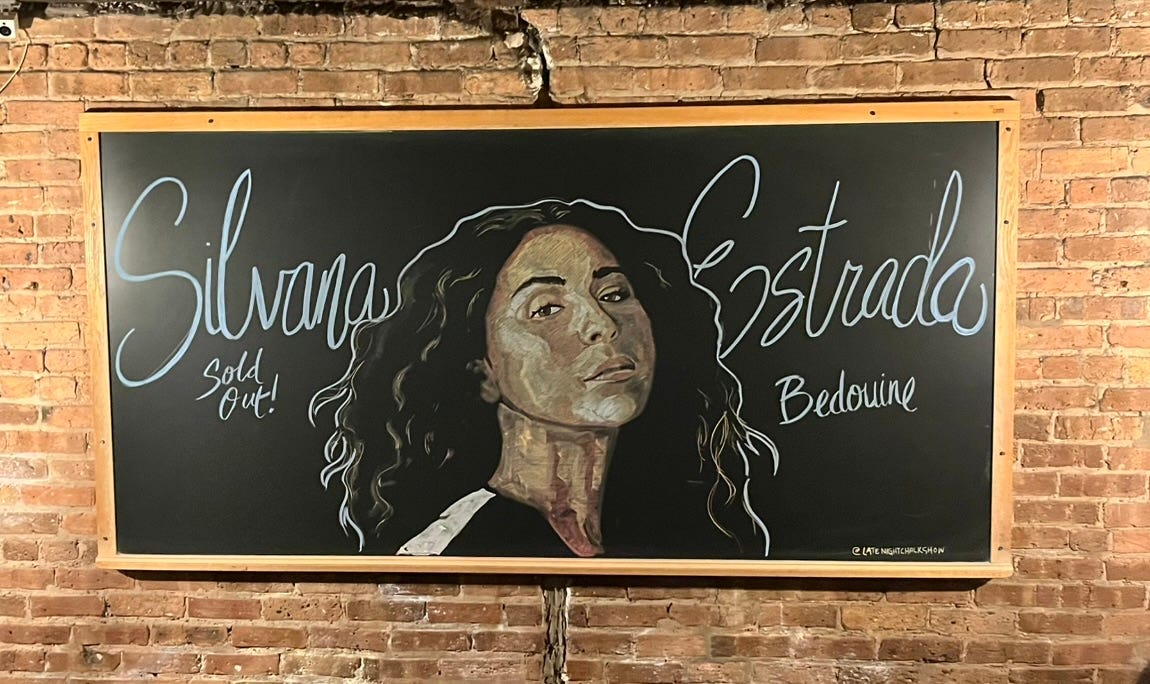
On the Weyes Blood parallel: what came through from the monologues was Estrada’s earnest and thoughtful approach to her art—exactly what I remember from Weyes Blood. Both of them had a song specifically about a friend’s death (“Un Rayo de Luz” for Estrada, “Picture Me Better“ for Weyes Blood). And they both clearly believe that a concert should be a communal experience.
On Spanish-speaking music: her closing song was the protest song “Solo Le Pido A Dios” by Leon Gieco, who is from Argentina. Other references throughout the concert made it clear that she listened to all kinds of music from elsewhere in Latin America2.
Given we were in Pilsen, a center of Mexican-American culture, with the background of federal immigration agents acting lawlessly in Chicago, a pro-immigrant message was all but expected during the show. It came in the form of Manu Chao’s “Clandestino”, maybe the most famous song about undocumented migrants.
Interlude—Pilsen and Thalia Hall
Pilsen is the German name for the Czech city of Plzeň, in the region of Bohemia. Also named after the city is the pilsner3, the original pale lager and the grandfather of all of the most popular beers on the planet (except Guinness). So you see this was a Czech/Bohemian neighborhood at one point.
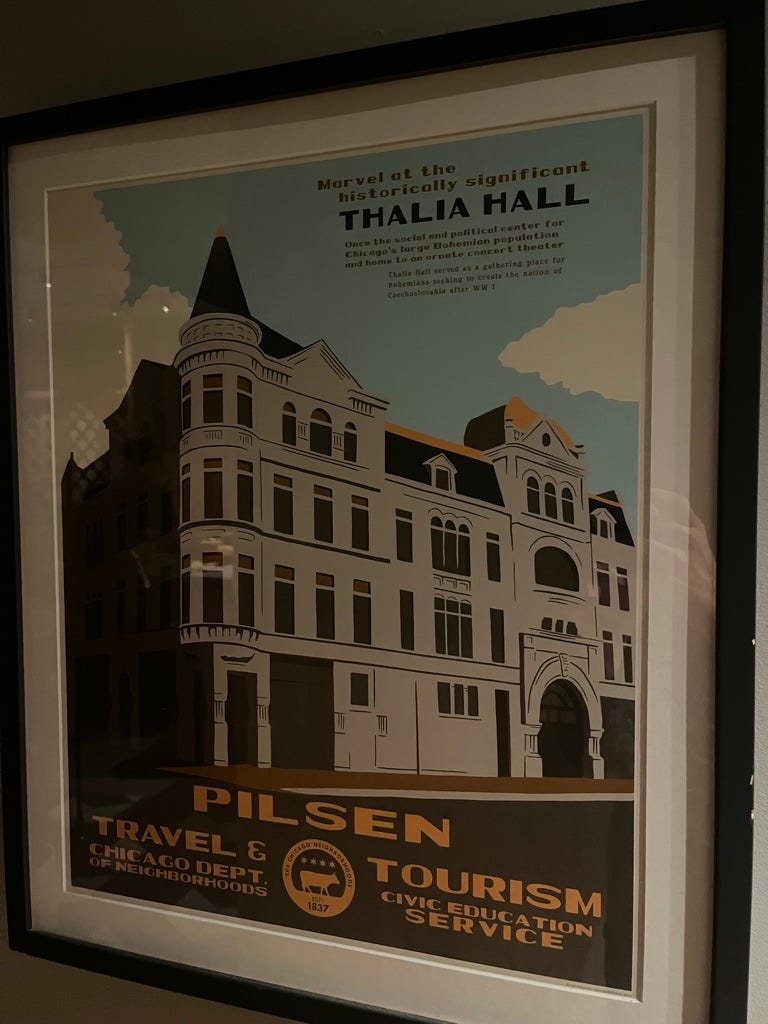
Czech immigration to America picked up after the failed uprising against the Austrian Empire in 1848, and many of the immigrants settled in Chicago. After the Chicago Fire in 1871 destroyed their initial neighborhood, they settled in Pilsen4.
Pilsen’s north and south boundaries are very clear: to the north are the railroad tracks on 16th Street, and to the south are industrial facilities on the Chicago River South Branch. The neighborhood was self-contained, with housing, shops, churches5, and communal spaces. One such community space was Thalia Hall, named after one of the muses in Greek mythology and built in 1893 by the Bohemian immigrant John Dusek6.
Thalia Hall hosted concerts, of course, and also held political meetings, where Czech nationalists plotted how they could gain independence from the Habsburgs. In an ironic twist, their success led to the end of Pilsen as a Czech neighborhood. After WWI in 1918, Czechoslovakia formed, and the flow of Czech immigrants stopped. More and more of the Czech-Americans became, well, Americans, and needed less and less of the Czech neighborhood.
The Mexican history of Pilsen starts in the 1950s and 60s, with the constructions of the Eisenhower Expressway (I-290), the Stevenson Expressway (I-55), and the University of Illinois Chicago campus, all just west of the Loop. We still know the area around the confluence of these big projects as Little Italy, but there were more Italians then, as well as Mexicans and other ethnic groups, and thousands of residents were displaced.
In Pilsen, the Mexicans found a plug-and-play neighborhood. Quoting one document that I found, “While the Bohemians had been the builders of Pilsen, the Mexicans were its preservationists.”7 The displaced Mexicans took advantage of the urban infrastructure that could meet all of their daily needs. So many of the buildings in Pilsen still date from the Czech days, but with murals created by the Mexicans, giving Pilsen a unique cityscape.
Pilsen has been a working-class neighborhood for most of its history, but it’s currently gentrifying, with rising housing costs8. For now, though, Pilsen remains the most transit-accessible Hispanic neighborhood in Chicago. And as immigration enforcement has led to lower foot traffic in neighborhoods with large immigrant populations9, I’ve been trying to support some businesses in Pilsen when I’m working remotely.
This truly isn’t a sacrifice on my part—just a slight inconvenience. I can personally vouch for only a very small subset of businesses there, but they include two purveyors of carnitas (Uruapan and Don Pedro), two very different kinds of birria (Birreria Reyes de Ocotlan and Quesabirria Jaliscos Tacos), cafes serving Mexican-style drinks (Café Carranza and Sleep Walk Chocolateria & Cafe), and a big Mexican grocery store (La Casa Del Pueblo)—see a map of all of this.
Mariscos San Pedro
Now, back to Thalia Hall.
It was lying dormant for many years, with only the lower levels utilized as a restaurant. It’s only in 2014 that the current owners restored the theater space above, and updated the restaurant spaces below. Thalia Hall books so many great acts that you shouldn’t need extra motivation to go there, but I’d been excited about Mariscos San Pedro, the Mexican restaurant that opened on the first floor in 202410, and that’s where we had dinner before the show.
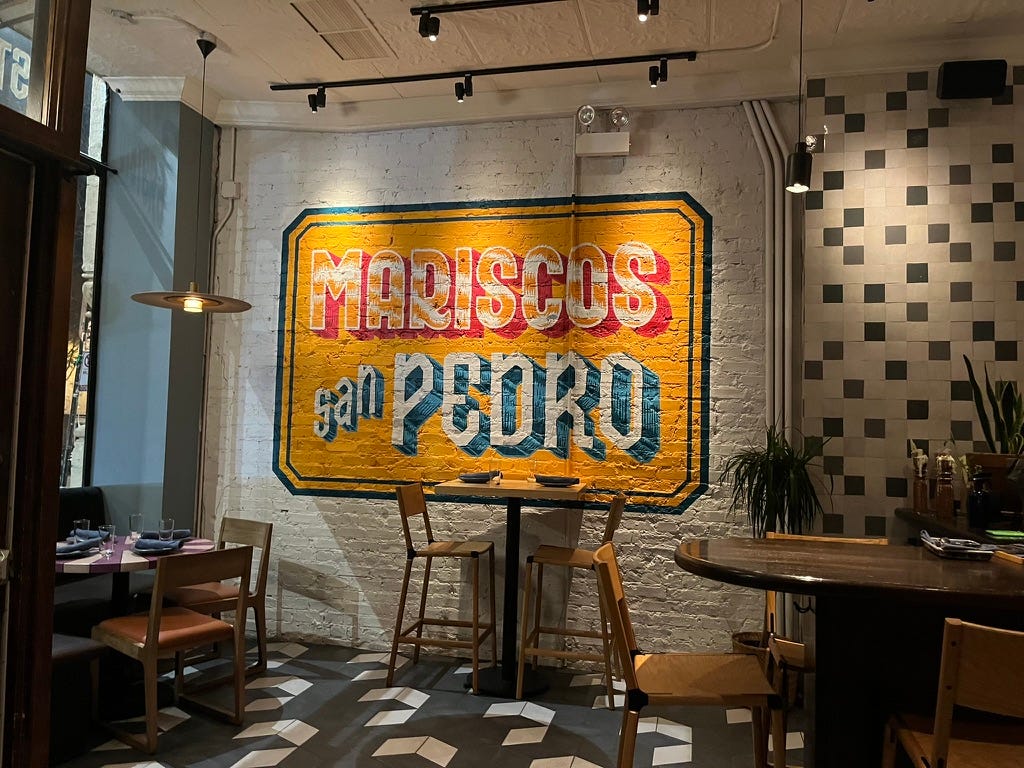
Mariscos means seafood in Spanish, and that’s what they specialize in. The chef also runs Taquería Chingón, a chef-y taco place in Fulton Market. Mariscos San Pedro is also very creative and not exactly an everyday staple kind of place.
One good example was their lobster quesabirria.
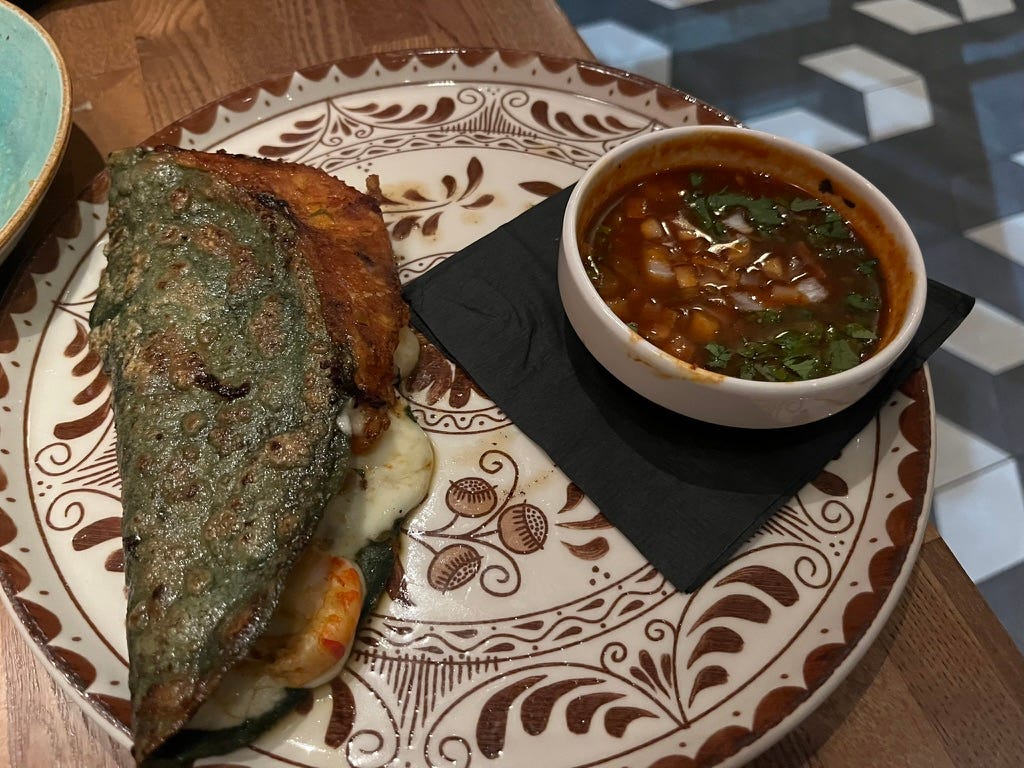
Quesabirria has been a trendy food item for a while, with photogenic red broth and bold flavors. Done badly, you end up with a greasy mess that you should only eat while young and starving. For this dish, they nailed the balance—you want a bit of a mess to make it fun, but have enough control so you can taste the lobster.
My favorite dish was the brandade dorados.
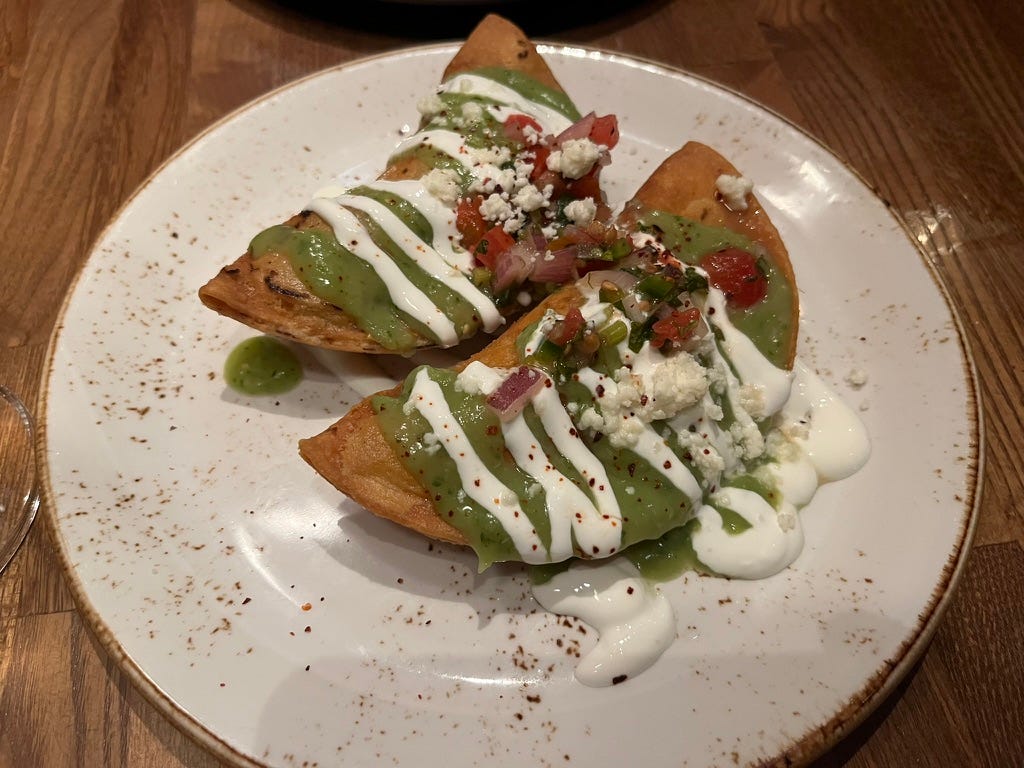
Brandade is a French dish that mixes salt cod, olive oil, and potatoes, and they put that in empanadas here. Hot potatoes with oil is already a killer combination, and the flakes of cod give you tingles with sharp hits of salt and umami.
The two of us shared three small-ish plates from the “cold” and “hot” sections, and that gave us some room for dessert. Their “mains” are probably better with bigger groups. In any case, everything we had was great.
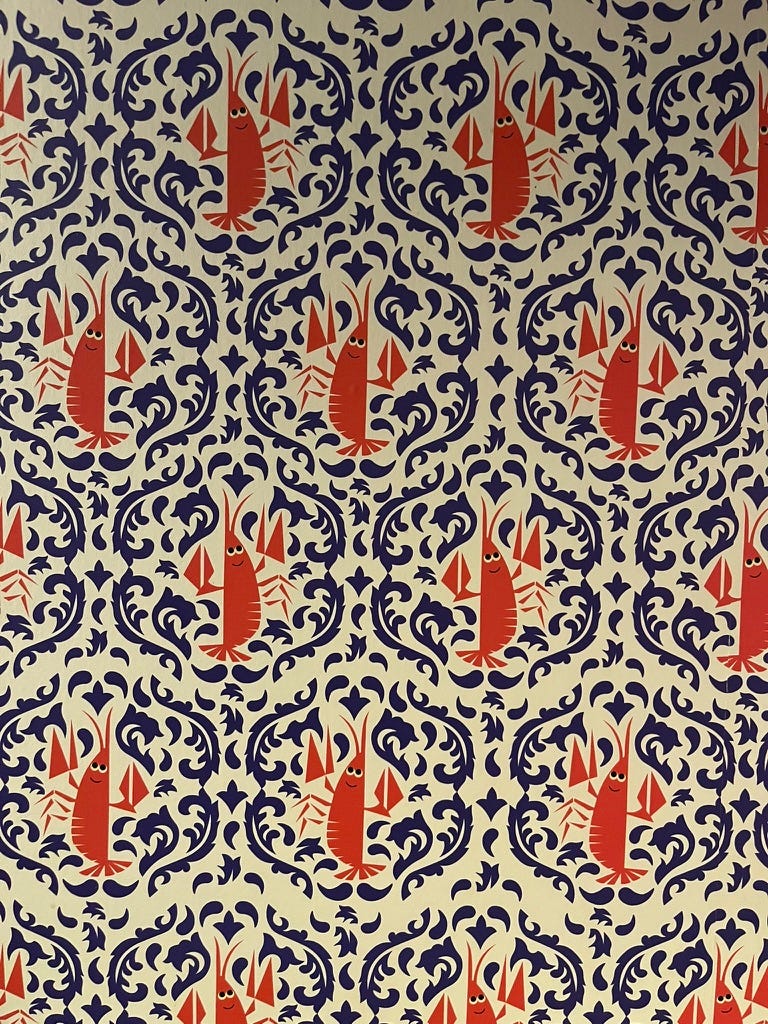
And I must end with a bathroom review: the wallpaper is fantastic.
So that was my favorite album, concert, and one of my favorite meals from 2025.
See you again in 2026!
Here’s my Open House Chicago post from last year.
as well as American—“USian”—music, actually.
and its original brewer, Pilsner Urquell, who started in 1842.
Czech & Slovak American Genealogy Society of Illinois has a webpage on the history of Pilsen, where they collected some documents related to the creation of the Pilsen Historic District. It’s not well-curated, but it’s a great resource.
WTTW also has a great article on Pilsen’s history.
Interestingly, one of the documents at the Czech & Slovak American Genealogy Society of Illinois page mentions that many of the Bohemian residents were Freethinkers, i.e. people who were skeptical of the church as well as other authorities, and they built their own secular organizations similar to churches.
On a separate note, the word “bohemian”—or boho—being used to mean unconventional lifestyle unfortunately has little to do with actual Bohemians. La bohème (like the opera) was a term used by the French to refer to the Romani, because they thought the Romani were from Bohemia. That’s perhaps not as inaccurate as the word Gypsy, which comes from the belief that they came from Egypt, but inaccurate nonetheless.
Multiple sources say that Thalia Hall was modeled after an old opera house in Prague. It’s not entirely obvious what building this is referring to.
The current opera house in Prague, the State Opera (Státní opera) opened in 1888, so it’s not impossible for the architects to refer to this building, but it was originally the theater building for German speakers in the city (Neues deutsches Theater).
More likely models are the building now called the National Theatre (Národní divadlo), which opened in 1881, or the Provisional Theater (Prozatímní divadlo), which opened in 1862 as the National Theatre was getting built around it. Both of these were explicitly Czech institutions from the start.
Long-time readers may know that my main prescription here is to build more housing in and around Pilsen, as well as in the general Chicagoland area, so that housing costs can be controlled. The 18th Street Pink Line stop is an obvious hub for denser housing. At the same time, we need housing assistance and subsidized housing for low-income residents so they could stay in the area.
Pilsen hasn’t been hit directly by federal agents in the way that the neighboring Little Village has been, but there has been significant impact on businesses that rely on people coming in to shop or eat in person.
I should mention that the restaurant that it replaced, Dusek’s Tavern, was no slouch and had a Michelin star.
I appreciate this callback to pilsen. During my time at Rush College I became close to the Lozano family, who are prominent in Pilsen and run the Lincoln Methodist church on S Damen. I enjoyed intimate moments at Thalia hall, I used to frequent community yoga classes there with my ex wife and I saw Ibeyi, a Cuban twin duo who sing in Yoruba at Thalia… I lived in east lawndale at the time.