Poetry
and how it keeps finding me
Short updates:
In the first week of the year, our 1-year-old got sick. In the second week, Julie and I got sick. In the third week, our 3-year-old started coughing but did not get too sick, and now in the fourth week, the 1-year-old gave us a scare with high temperatures one night but he might be OK—we’ll see.
Federal immigration agencies are still in the news1. In a convergence of two of my recent posts, Thalia Hall held a public meeting on whether the Chicago Police Department helped ICE in their operations in the city.
The Monks in the Casino by Derek Thompson pulls together many strands to talk about how so many young American men have failed to find lives with true joy, which comes from connecting with others.
Last November, before issuing a ruling to restrict the use of force by federal immigration agents, US District Judge Sara Ellis read Carl Sandburg’s poem “Chicago”.
The context: Trump administration’s justification for its Operation Midway Blitz in the Chicago area was that we are supposedly overrun with immigrants who should not be in the country and are committing crimes, and that the operation would target such dangerous people. When people started showing up to protest or to observe and witness the agents’ activities, the administration began to paint the area as full of rioters, who are forcing agents to use tear gas and pepper balls. The judge clearly saw all that as bullshit.
The Sandburg poem—if you’re not familiar with it, please read it here—is from 1914, and full of anachronisms. For one thing, Chicago hasn’t been “Hog Butcher for the World” for more than 50 years. But Chicagoans still have pride for their city and disdain for outsiders who put it down:
And having answered so I turn once more to those who sneer at this my city, and I give them back the sneer and say to them
Whatever you may think of a judge reciting poetry, I found it remarkable that a poem from 111 years ago crystallizes how so many people feel right now.
This was one of many events and circumstances that converged on me in the last few years, making me read more poetry in the past year than all the years before that in my life.
There are some art forms that you’re naturally drawn to, and others you’re not. You all know that for me, food and music fall in the former category, and you might know that television and film fall in the latter. Poetry is another one that is not a natural fit for me—you may have known this from my writing style, too2.
I do think there’s value in specializing, digging deeper into things that you have deeper feelings for. But it’s a loss to completely close yourself off from a whole art form—there are things songs can do that novels can’t do, things poems can do that movies can’t do, etc. So I had been keeping my mind open for poetry, even if I wasn’t seeking it out.
Here are some more of my encounters with poetry.
Last year, I came across an online syllabus for “Great English literature”3. The author is unequivocal about the value of poetry:
And remember: we live in a benighted age that thinks “storytelling” is a high art. But poetry is the heart of literature. What we most justly love in great literature is language, character, pleasure, beauty, truth, imagination, and the promulgation of virtue. Storytelling is an important aspect of literature, but it is given far too much prominence in modern culture.
This led me to following its recommendation—more on that near the end.
Another catalyst has been the Atlantic. I’ve had a print subscription for years, and they print a poem every issue. It’s given me a slow but consistent exposure to contemporary poetry.
One particular poem, “The Unspoken” by Ada Limón, left enough of an impression that I checked out her book The Hurting Kind from the library last year. Here’s one of the poems that I liked from the book, “Cyrus & the Snakes”, about a childhood episode of her brother holding a snake, and how that episode reflects on his character and the relationship between humans and non-humans.
I wrote about my grandmother last year, and mentioned that she has a book of poetry that she published in the 1990s. During Thanksgiving, I was able to read the book at my parents’ place.
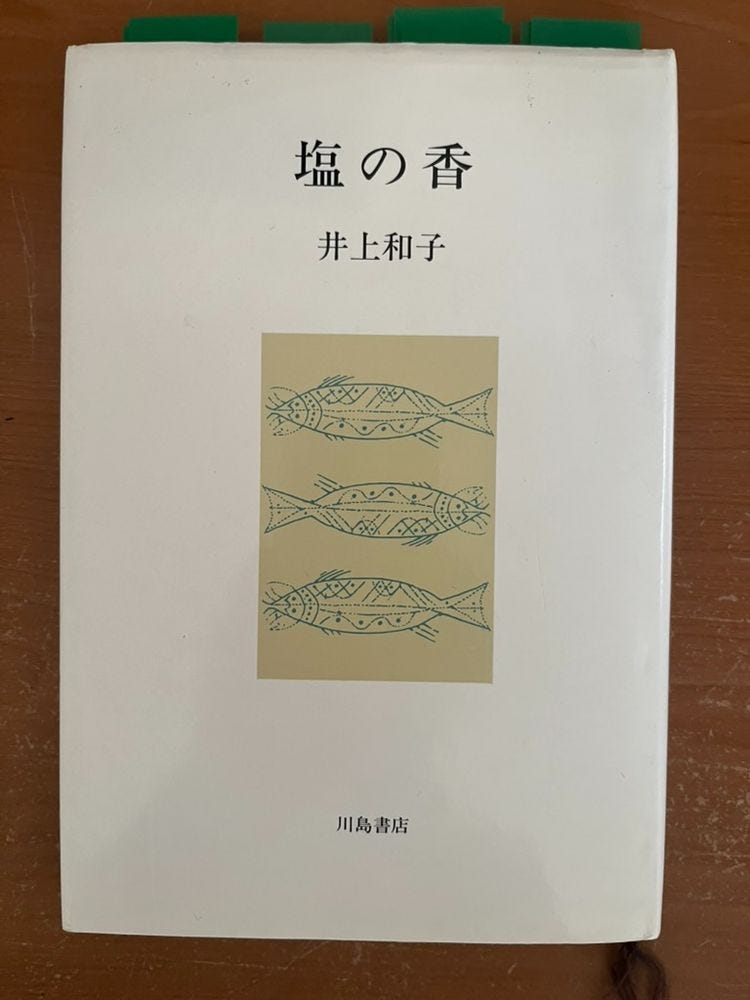
As I suspected, in this book were depths of feeling about people and events in her life that she wouldn’t volunteer in conversation with a grandson. I have been sharing some of my favorites on Bluesky (the Japanese thread here, and my translations to English here).
Some of the poems are impossible to translate without losing the poetry—how do I translate amanattō? Even for the ones I was able to translate, I’m essentially writing a poem in English that preserves as much of the meaning and the feeling of the original as I can.
Many children’s books involve poetry, and my favorite children’s book resource, Can we read?, often explicitly highlights poetry books. But more than that, reading to kids involves getting in touch with how words on the page get turned into sound. Appreciating that physicality of reading may have been a necessary step for me, before going further into poetry.
There’s of course classics like Dr. Seuss’s books and Goodnight Moon. Among more recent books with obviously poetic text4, our 3-year-old enjoyed The Gruffalo and Goodnight, Goodnight, Construction Site.
Now back to the syllabus: it recommends going through The Oxford Book of English Verse, an anthology of poems in English, to see what you are drawn to. Starting with anthologies is actually a common recommendation for getting exposure, but the mention of a particular anthology helped me get started. That anthology turns out to be British-heavy, so I’ve also been looking at The Oxford Book of American Poetry5, and I’ve gotten to people born in the early 1800s on both.
Now that I think about it, going through an anthology is similar to how I sometimes get into a musical genre or a scene that I’m not too familiar with—go through a curated playlist and dig deeper on songs and artists that I like.
What I’m liking out of these poems also has a parallel to music. In music, I’m with Ella Fitzgerald6—it don’t mean a thing if it ain’t got that swing. You could call it swing, groove, flow. If the music has a good rhythm, and all its elements work to enhance that, that’s a good song already in my book.
Likewise, I’m finding that when a poem has great rhythm, I don’t particularly care that I don’t fully understand what it’s saying. I can appreciate that many of the best-known poets choose the right words to make the lines flow much better than others. Two examples from poets that I hadn’t read before: John Dryden’s “To the Memory of Mr. Oldham” and Emily Brontë’s “The night is darkening round me”. It’s hard to articulate why these work for me—you should read them out aloud and see if they work for you.
I’ll end with a hot take: William Wordsworth does not do this at all.
What I’m listening to now
Pilot Light is Liam Kazar’s second album.
Kazar is from Chicago, with a lot of backstories locally, like how he has multiple musicians in his family, and his connections to other great local artists like Jeff Tweedy of Wilco and Macie Stewart.
But I think the music speaks for itself. On average, it’s in a Wilco-like indie folk space, with some songs like “Day Off” veering into alt-country, and others going more pop. His range is impressive—the debut album Due North was also great, and that even had a few funky R&B songs7.
“The Word The War” and “Didn’t I” are my favorite songs here.
And they should be as long as there is no accountability for their actions, in the future and in the past.
I remember telling people over the years that I don’t really get poetry, and one person did give me useful advice, which was to take note of phrases and sentences that I like, and that would help me get it eventually.
Thinking over, what might have helped me even more at that time was thinking about sayings I did not like, because there’s a lot more of them. This is a different problem from me and movies/TV, where I rarely have strong negative reactions.
This is part of a website of syllabi, affiliated with the Works in Progress magazine. They seem to have stopped updating it, which is a shame because the other syllabi look pretty good as well—”Cities” and “Housing supply” are topics close to my heart.
I just mean books with rhyme. There’s other books that I think are poetic—Nana in the City and From My Window, for example—but it seems more subjective.
I actually started trying to read American Poetry with Library of America’s anthology, but it had too many poems for my purposes.
or apparently, the trumpeter Bubber Miley, according to the Wikipedia page on the song.
And I just found out that he was running an Armenian pop-up restaurant.
Another resonant post for me.
I cut my literary teeth on Alan Ginsberg, jack Kerouac, Hemingway and bukowski. I used to spend a long time writing and reading poetry and I do think it left big impacts on my literary sensibilities. What a precious memento from your bachan. What form were the poetry in?