Euro step isn't a travel
Pre-trip reading for Copenhagen and Malmö

Short updates:
This post is about the preparation for our imminent Denmark/Sweden trip. Sweden is in the FIFA World Cup, and I’m hoping they go out early—and it’s not because they’re in the same group as Japan1. It’s one thing to see everyone being excited about their soccer team, but realize that there’s a 7-hour time difference, so when we’re in Sweden, they could be playing a game around midnight or early morning. I’d rather not deal with kids waking up from the noise2.
Happy belated Father’s Day! Here’s a great essay on being a dad, from earlier this year.

2 months ago, I talked about some books I checked out from the library to prepare for our trip to Copenhagen and Malmö. I’m here to report back on the books, and I want to make a case for this kind of pre-trip preparation.
When I’m traveling alone, I often cover a lot of distance every day, and either cram in a lot of activities that I knew about in advance, or explore with no particular goals in mind. This did happen in Charleston last month, when I got in 2 good meals, a museum, and souvenir shopping on the last day before my afternoon flight.
When I’m traveling with the kids, though, this just isn’t realistic. They can’t walk as fast, they need more breaks, and there’s always something that doesn’t go as planned. With kids, you need to underschedule, making sure you leave time for breaks, and lower your expectations for how much you can do in a day.
That all sounds like a bad thing, but it simply changes what your trip is about. With a slower pace, you can be more present at each moment, not always trying to rush to the next destination. Instead of checking things off of a list, you can focus on experiencing life at a different location.
When you accept that this is your goal, your trip prep becomes less about figuring out all the things you want to do and fitting them into your schedule, and more about enriching your experiences by getting a better feel for where you’ll be. What does it look like, what did it look like, what do the people do, think, know, and feel? You want to find good things to read, watch, and listen—whatever floats your boat—from your destination, and take them in before the trip.
I’ve done this before
In 2019, Julie and I went on our honeymoon to Rome. For that trip, we wanted to take it easy—we’d traveled together and knew we wouldn’t enjoy getting wiped out with days of walking. So we spent 10 days, all in Rome rather than traveling around, and managed to avoid the temptation of scheduling 3, 4 things every day.
Before the trip, I read 3 books, and we watched 6 movies together3. Rome must be one of the best cities in the world for this kind of prep. There’s so much great art about Rome, you’ll like a lot of it, and you’ll enjoy it more when you know you’re going there.
And did the media consumption beforehand help me enjoy the trip more?
Does watching the Trevi Fountain scene in La Dolce Vita enhance the experience of going to the Trevi, even though you’re there with hundreds of other tourists instead of alone after midnight with a Swedish actress? Yes.
It was also interesting to see how well things got captured on film. The Trevi does well on film, and it’s also great to see live. The Spanish Steps look much better than they really are. And the Pantheon, my favorite, you cannot capture the experience on film, at all.
One thing I remember vividly from the readings: in SPQR, Mary Beard describes the Arch of Constantine, just outside the Colosseum, as a symbol of Rome’s decline—most of the relief sculptures were cut off and transplanted from older monuments. Rick Steves, on the other hand, acknowledges all that and still considers the monument a successful tribute to the first Christian emperor. This isn’t about figuring out who’s right. Knowing these opinions gives you more filters to understand what you’re seeing.
This trip was before the kids, so you can tell that this isn’t merely a coping mechanism.
Copenhagen and Malmö reading list
Here’s the list of books, in the order that I read them:
alphabet by Inger Christensen (Denmark, poetry)
Doctor Glas by Hjalmar Söderberg (Sweden, novel)
A Dream Play by August Strindberg (Sweden, play)
Seven Gothic Tales by Isak Dinesen (Denmark, short stories)
How to Study Public Life by Jan Gehl & Birgitte Svarre (Denmark, non-fiction)
Life Between Buildings by Jan Gehl (Denmark, non-fiction)
I just finished Life Between Buildings. I saved the last short story in Seven Gothic Tales for when I’m in Copenhagen, and I’m planning on reading this last one in Malmö:
Murder at the Savoy by Maj Sjöwall & Per Wahlöö (Sweden, crime fiction)
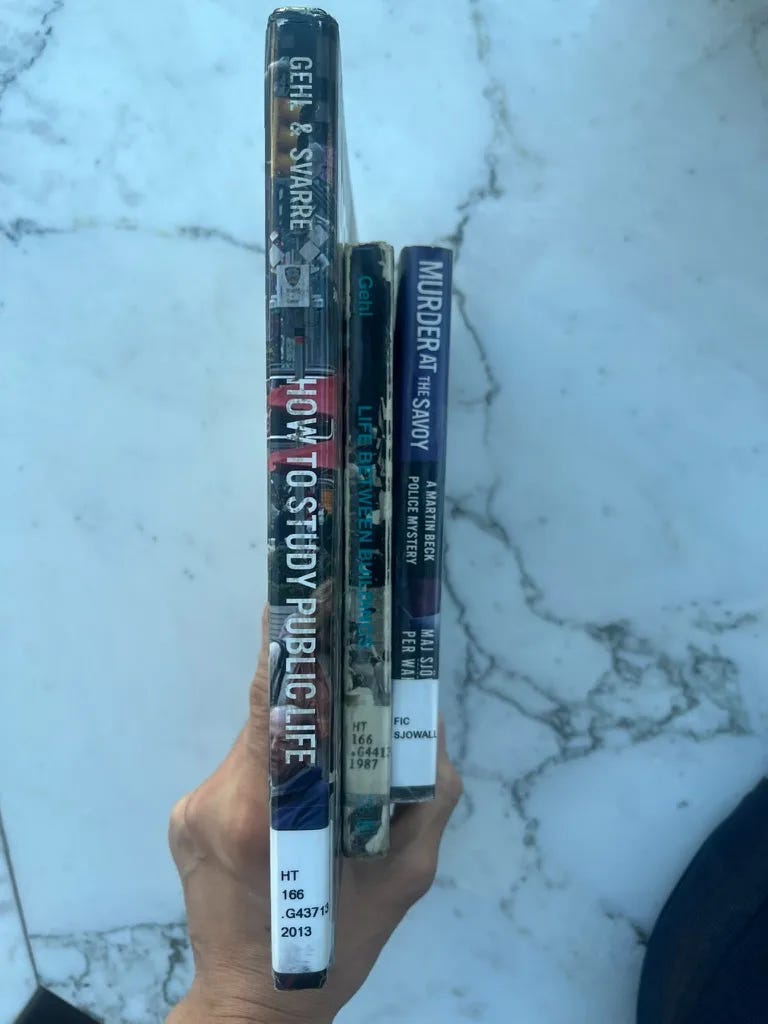
I want to thank Amy Cavanaugh for pointing me in the direction of Swedish crime fiction in the comments. At some point, I may check out Faceless Killers, the first book in the Wallander series that she recommended, because that book is set in the countryside not too far from Malmö. I decided to go with Murder at the Savoy, which is set in the city of Malmö itself.
And as always, I have to thank the public library that lets me check out all these books for free.
movie & music
We just watched Another Round, a 2020 Danish film starring Mads Mikkelsen4. It’s about middle-aged teachers experimenting with drinking on the job to improve performance—the trailer is pretty accurate. We enjoyed it, and took in images of Copenhagen and its surroundings.
I’d actually listened to quite a few Copenhagen-based artists over the years. I talked about the Korean-Danish artist Ki! here. There are also slightly offbeat indie artists like ML Buch, Astrid Sonne, and Lowly. Copenhagen has a big jazz scene, and at the moment my favorite is the percussionist Marilyn Mazur5.
I’ll come back to music from Malmö at the end.
Highlights
In terms of sheer enjoyment, here are the 2 best things I’ve read:
alphabet is a book-length poem with the theme of nuclear warfare, but it’s also about everything. There are 14 sections to the poem, each corresponding to a letter of the alphabet from A to N, with the number of lines in each section growing like the Fibonacci sequence. As each section gets longer, you sense that we’re building from something small—“apricot trees exist”—to something cosmic. The Fibonacci sequence is also about uncontrolled exponential growth, which is exactly what a nuclear chain reaction in a bomb is.
“Roads Round Pisa” is my favorite story in Seven Gothic Tales (so far). It’s a tightly constructed short story where things fall in place like a jigsaw puzzle. If you like Borges, you’ll like the collection—there’s a fable-like quality to the stories. Recurring themes are romantic love, marriage, and the connection between them (or lack thereof), and how people play roles as if on stage, especially with respect to gender6.
Even outside of these, I’ve liked everything I’ve read, but what am I getting out of them in terms of the trip?
Some of it reinforces what I knew already.
A lot of the imagery in alphabet comes from nature in Scandinavia with its trees and berries.
Seasonality is a big deal, especially the long days around midsummer. Doctor Glas starts around summer solstice, and the main character remembers his younger days when he went to celebrate midsummer in a field. I had just read that Scandinavia was historically much more sexually permissive than elsewhere in Europe, and that cultural aspect was confirmed in Doctor Glas as well.
Something I was less familiar with: “The Supper at Elsinore” is a story in Seven Gothic Tales that didn’t click for me as much as the others, but it’s the one that actually takes place in Denmark7. It’s about two noble sisters in Elsinore and their brother, who becomes a privateer (basically a pirate but with government authorization) in the Sound (Øresund), the narrow strait between Denmark and Sweden. You get how much of a seafaring culture there was8, and just how narrow the Sound is.
From fiction, I’m trying to get immersed into some aspects of the culture, but Jan Gehl’s urbanism books are more directly useful for seeing what’s there now.
Life Between Buildings is a book that highlights the benefits of street life—how with the right conditions, people can connect with their friends and neighbors without having to make special plans. It covers a lot of the same ground as Jane Jacobs’ classic The Death and Life of Great American Cities, but what’s wonderful is that Gehl, being an architect, always gives visual illustrations for his ideas.
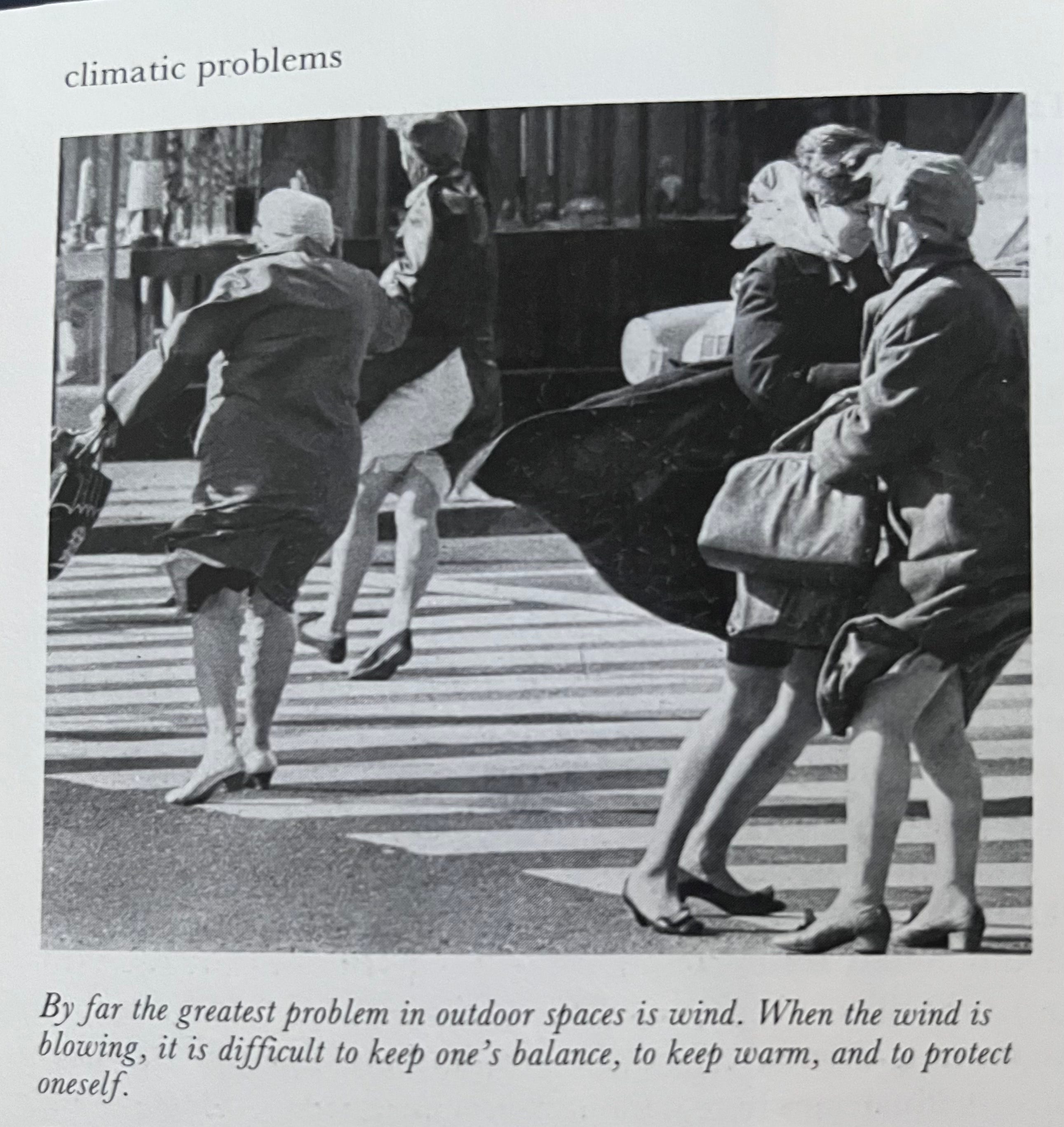
After reading Life Between Buildings and How to Study Public Life, a more recent Gehl book, it’s clear that Copenhagen made a concerted effort to improve public spaces over decades. Strøget, its main downtown shopping street, and Nyhavn, a waterfront district by a canal, were not always car-free like they are now. Harbour Baths, a system of swimming areas in the sea, did not exist until 2002. And these changes weren’t always popular:
When [Strøget] was converted to a pedestrian street in 1962 as the first such scheme in Scandinavia, many critics predicted that the street would be deserted because “city activity just doesn’t belong to the northern European tradition.”9
—Jan Gehl, Life Between Buildings
This kind of objection is something we hear in the US, when someone tries to make car-free streets. I’ll see these spaces, and know that we can also have nice things.
What I’m listening to now
This is the 2005 album Alla vill till himmelen men ingen vill dö, by the Swedish rapper Timbuktu.
He’s from Lund, a medieval cathedral-and-college town near Malmö. His father is African-American with recent roots in West Africa, and that’s where the name Timbuktu comes from.
He sings in the regional (Skåne) dialect of Swedish—well, I barely know any Swedish after a couple months of Duolingo so I don’t know how that presents itself. But there’s a wide variety of funk and funk-adjacent music here, from American to African to reggae. I especially liked “Generellt” and “Nu“, both on the African side.
I used to kind of cheer for the Netherlands in the past, but it’s also not relevant.
I’ve mostly avoided watching the World Cup after 2010—a long story in itself, but mostly because FIFA is extremely corrupt and because the teams are not as good as the top clubs, who have top players for multiple countries and practice together most of the year.
What I care about more than any national team’s results is for Arsenal players to do well and return healthy, and if anything, that would argue for Viktor Gyökeres to do well for Sweden.
I think the only exception is if they end up playing Norway in the Round of 32. That would make it more fun—but it would start at 11 p.m.
Books: SPQR by Mary Beard, I, Claudius by Robert Graves, The Swerve by Stephen Greenblatt.
For someone doing this now, I’d definitely suggest Katie Parla’s 2 Rome cookbooks (Tasting Rome, which is lighter, and the encyclopedic Rome).
Movies: Rome: Open City, The Bicycle Thief, Roman Holiday, La Dolce Vita, The Talented Mr. Ripley (by far the least Roman film in the mix), Bangla (yes, that was a recent indie film set in Rome). We’d watched The Great Beauty a while before that.
Music: I discovered some really good indie artists from Rome leading up to the trip: Fulminacci, Galeffi, and Ditonellapiaga. Fulminacci and Ditonellapiaga seem to be a lot more popular (in Italy) now than when I found them.
Mads Mikkelsen does a lot of Danish movies (filmography), and checking those out looks like a viable way of getting into Danish cinema.
who unfortunately died last year.
Probably related: Isak Dinesen was the pen name of Karen Blixen, so she was writing under a male name (Isak is the Danish version of Isaac).
Elsinore, or Helsingør in Danish, is where Hamlet’s castle is, and it’s at the narrowest part of the Sound.
All the other stories in Seven Gothic Tales take place outside Denmark, but there are often Nordic characters, and you could also read into how these characters are portrayed.
They still kind of do: the largest Danish company is the shipping company Maersk.
I also know that the critics are simply wrong on what those “traditions” are. Doctor Glas, set in Stockholm in the 1890s, has many scenes where characters encounter each other because they are eating, drinking, or just hanging out in public.
I'm glad my recs were helpful - I hope you have a great trip! And I'm with you on this - particularly when traveling internationally, I love to align pre-reading with the destination. Such a fun way to get excited for the trip and immerse yourself before you even arrive.